Definition
What Is Biochar?
|
Biochar is a carbon-rich, charcoal-like material created by heating organic biomass — crop residues, wood chips, forest waste — in a controlled, low-oxygen process called pyrolysis. Unlike ordinary charcoal used for cooking, biochar is specifically engineered to store carbon safely, improve soil health, and reduce environmental pollution. During pyrolysis, organic matter decomposes at high temperatures with minimal oxygen, transforming biomass into a stable carbon form that resists decomposition for centuries. Simultaneously, renewable heat energy is released — making biochar a genuinely carbon-negative technology. Physically, biochar is black, lightweight, highly porous and fine-grained, with an extensive surface area. Chemically, it is approximately 70% carbon, with the remainder composed of nitrogen, hydrogen, oxygen, and trace minerals. |
Biochar produced at MARDI’s farm — fine-grained, porous black carbon |
70%
Carbon content in biochar by weight
2,000+
Years of documented use in Amazon basin
100s
Years carbon stays locked in the soil
CO₂↓
Carbon-negative — removes more CO₂ than it emits
Ancient Knowledge
Terra Preta — The Dark Earth of the Amazon
Long before modern science, indigenous farmers of the Amazon had already discovered the extraordinary power of charred soil.
Over 2,000 Years Old — Yet Still Fertile Today
More than two millennia ago, indigenous Amazonian communities enriched their soils by burying charred organic matter — creating what we now call “Terra Preta” (meaning “dark earth” in Portuguese).
Even today, these ancient soils remain remarkably productive and carbon-rich, in stark contrast to the poor, leached soils surrounding them. This living proof of biochar’s longevity spans more than 80 generations of farming — and was the inspiration for MARDI’s adoption of this technology.
A Carbon-Negative Technology
Biochar production removes more CO₂ from the atmosphere than it emits. When crop and farm residues are converted to biochar, their carbon is stabilised and locked in soil for centuries — actively reducing atmospheric CO₂ levels while improving your farm’s productivity.
Production Process
How Biochar Is Produced
Biochar is created through pyrolysis — thermal decomposition of biomass in an oxygen-limited environment. It can be produced on a small farm scale or at an industrial level.
01
Collect Feedstock
Dry crop residues (stalks, husks), wood chips, dry leaves, or organic farm waste with 10–20% moisture and high lignin content.
02
Pyrolysis — TLUD Method
Biomass is heated in low-oxygen conditions. The Top-Lit Updraft (TLUD) method is preferred on farms for minimal smoke and efficiency.
03
Quench & Collect Biochar
The biochar is quenched with water to stop combustion, then collected. Clean energy released during the process can also be captured.
04
Charge with Compost
Mix with compost, manure, or Bio-slurry (Jiva-Amrut) to “charge” it with nutrients and beneficial microbes before soil application.
|
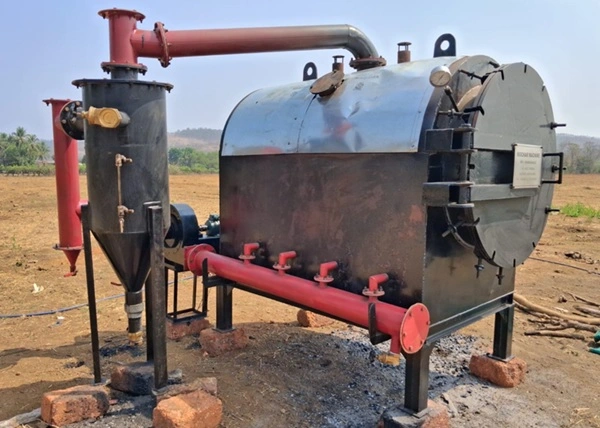
Biochar production machine at MARDI’s Manas Krushi Farm, Shahapur |
Production at MARDIAt Manas Krushi Farm in Shahapur, near Mumbai, MARDI operates its own biochar production unit. We use farm-generated biomass — crop stalks, dry leaves, and organic waste — as feedstock. The produced biochar is charged with Bio-slurry (Jiva-Amrut) from our on-site Bio-Digestor before application, creating a highly potent soil amendment. MARDI provides hands-on training in biochar production as part of our Advanced Organic Farming programme — so you can implement this technology on your own farm. |
Material Guide
Feedstock Quality Guide
The quality of biochar depends heavily on the feedstock used. Choose wisely for safe, effective results.
| Feedstock / Material | Suitability | Reason / Notes |
|---|---|---|
| Woody biomass (branches, wood chips) | Ideal | High lignin content, consistent quality, good carbon yield |
| Crop residues (stalks, husks, straw) | Ideal | Widely available on farms, very suitable for TLUD method |
| Dry leaves, garden waste | Ideal | Works well, no contamination risk |
| Organic farm waste | Ideal | Promotes circular, zero-waste farm management |
| Industrial waste, railway wood | Avoid | May contain heavy metals, chemical preservatives, or toxic compounds |
| Wet or freshly cut biomass (>20% moisture) | Avoid | Incomplete pyrolysis, smoke, and lower carbon quality |
| Plastic, rubber, or synthetic materials | Avoid | Releases toxic gases — unsafe and harmful to soil |
Applications
Benefits & Applications in Agriculture
Biochar works through multiple pathways to transform degraded soils into productive, resilient farmland.
Soil Health Enhancement
- Improves soil structure and aeration
- Increases water retention capacity
- Reduces soil acidity (raises pH)
- Improves nutrient retention, reduces nitrogen leaching
- Promotes beneficial microbial activity
- Reduces nitrous oxide (N₂O) emissions
Improved Composting
- Accelerates decomposition by stimulating microbes
- Reduces ammonia loss and foul odour
- Minimises greenhouse gas release during composting
- Produces richer, more nutrient-dense organic manure
Climate & Environment
- Sequesters carbon for hundreds of years
- Reduces dependence on chemical fertilisers
- Cuts greenhouse gas emissions from farmland
- Supports India’s climate commitments
Farm Economics
- Reduces external fertiliser input costs
- Produces clean energy as a by-product
- Converts farm waste into valuable product
- Opens revenue through carbon credit markets
Field Application
How to Apply Biochar to Your Farm
Correct application is critical. Raw biochar must always be “charged” before use. For sandy or highly degraded soils, higher application rates are recommended.
Step 1 — Charge the Biochar
Always mix biochar with compost, farmyard manure, or liquid organic fertiliser (like Bio-slurry / Jiva-Amrut) for at least 2–4 weeks before field application. This loads it with nutrients and beneficial microbes.
Step 2 — Determine Application Rate
Normal soils: 2–5 tonnes per hectare. Sandy or degraded soils: 10–20 tonnes per hectare. One-time deep application with ongoing composting gives the best long-term results.
Step 3 — Incorporate into Soil
Spread charged biochar evenly and incorporate into the top 15–30 cm of soil. Avoid surface application without incorporation to prevent wind loss.
Step 4 — Monitor & Repeat
Biochar’s benefits accumulate over time. Continue adding biochar-enriched compost annually. Biochar works best as part of a complete regenerative system.